
-900x250.jpg)
Key Stage Three (Years 7&8)
This page summarises the topics your child will study during Years 7 and 8 at Sharnbrook Academy.
We are committed to delivering a high-quality education and school experience to ensure the young adults who leave our care are prepared for the next stage of their education and are ready and confident to move forward as responsible and employable citizens.
Our planning and delivery of knowledge and skills in Years 7 and 8 is shaped by the Meridian curriculum. You can find out more about the Meridian curriculum by clicking this link https://www.cmatrust.co.uk/our-curriculum/ .
The Sharnbrook Curriculum delivers:
- High-quality teaching and support through our House/Curriculum team structures;
- A dynamic curriculum that provides a breadth of academic, artistic, technical and practical courses to meet the needs of every student;
- Personal support for every student from their teachers;
- Effective monitoring of student performance against challenging individual targets;
- Robust support systems and flexible and effective intervention programmes;
- High expectations of what every child can achieve.
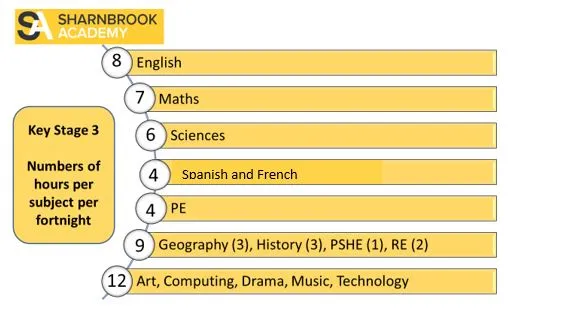
Teaching group sizes vary according to the subject or the nature of the activity but the average class size in Years 7 and 8 is around 30 students. Setting (grouping on ability) occurs throughout years 7 to 11 in various subjects, from ability sets to mixed ability bands.
The two-week timetable consists of 25 lessons per week, with lessons lasting 60 minutes, plus 20 minutes a day for tutorial/assembly times.
The normal timetable is suspended for occasional enrichment days at appropriate points during the academic year. This allows longer periods of time to be devoted to relevant learning experiences.
We believe that:
- In Years 7 and 8 students should experience the broadest curriculum possible with exposure to a range of subjects taught in a manner that will allow them to progress to GCSE study and beyond;
- Students should be challenged to achieve their full potential. Whether they are more able in a subject or working below age-related expectations, work should be challenging and accessible enough to meet their particular needs;
- The National Curriculum sets out a clear entitlement to core knowledge at Key Stage 3 that all students should gain;
- We are preparing students not just for exams, however important these might be, but also equipping them with the skills to be successful in life;
- Feedback in all its forms should be focused and clear to enable students to understand how they can improve.
Assessment and Reporting
Students in key stage 3 are assessed in relation to national expectations within each curriculum area. The grading criteria is as follows:
- Exceeding National Expectations (Ex) – indicating the potential to achieve Grades 8 – 9 at GCSE
- Above National Expectations (Ab) – indicating the potential to achieve Grades 6 – 7 at GCSE
- In Line with National Expectations (IL) – indicating the potential to achieve Grades 4 – 5 at GCSE
- Working Towards National Expectations (WT) – indicating the potential to achieve Grades 1 – 3 at GCSE
This grading criteria can be seen applied to each subject in the column titled ‘CI’, standing for ‘Current Indicator of Attainment’. CIs are set using nationally benchmarked data and reviewed using ongoing assessment information to give a broad overview of future potential. For example, a student with a CI of Ab in a subject is showing, based on their prior attainment, the potential for a GCSE grade of 6/7.
Progress grades give a broad indication of the progress a student is making in each subject, based on their homework, classwork, and classroom assessments towards their CI.
- P+ Making quicker than expected progress
- P Making the expected rate of progress
- P- Making less than expected progress
Curriculum: ckeating-roberts@sharnbrook.academy
Assessment: lwatt@sharnbrook.academy